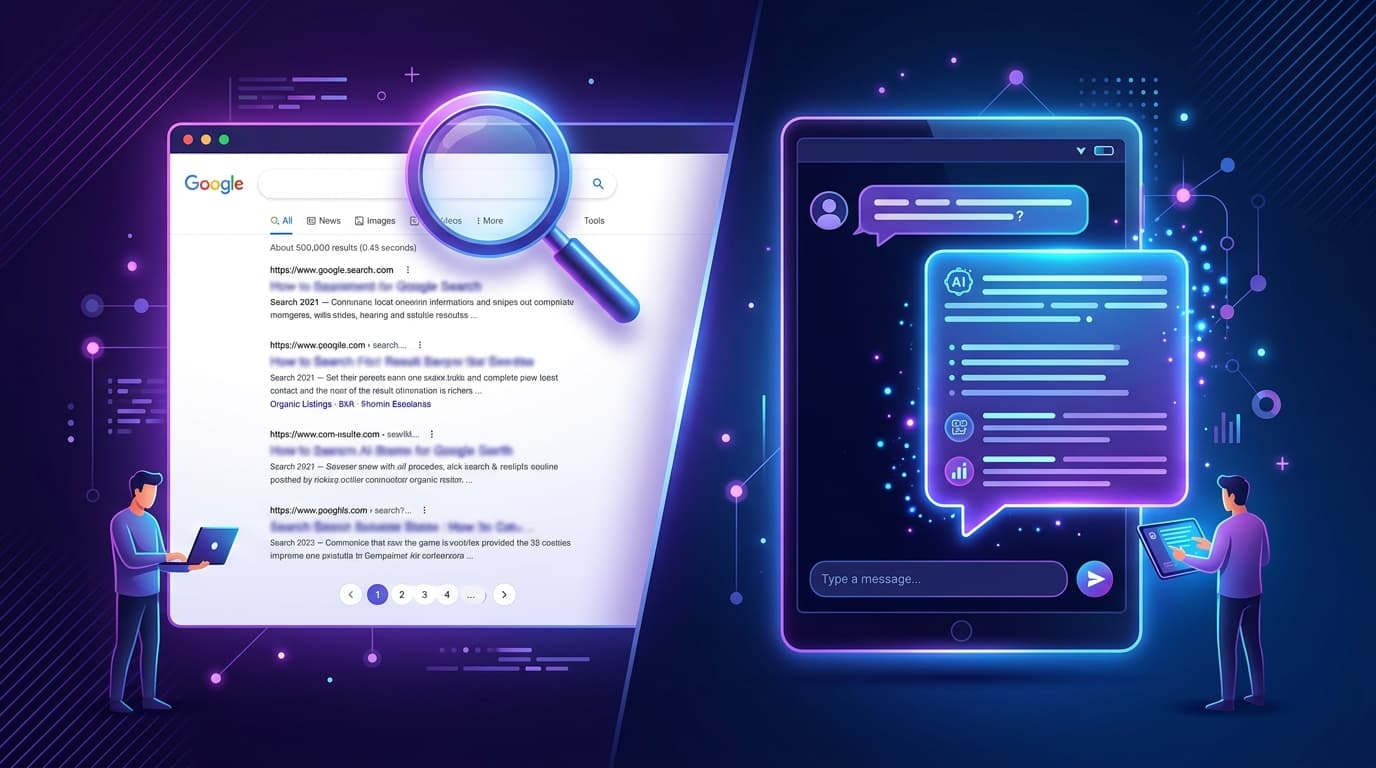
Why This Question Matters More Than Ever for Indian Business Owners
Indian search behaviour changed more in 2024 and 2025 than in the previous decade combined. According to Google's own data, AI Overviews now appear on more than 30% of searches globally — and India, as one of Google's largest and fastest-growing markets, is fully in the middle of this shift. A 2025 report from Redseer estimated that over 45 million Indians actively use AI chatbots like ChatGPT and Gemini to answer business-related questions every month.
What this means practically: when a business owner in Surat searches "which accounting software should I use for GST filing," they are no longer necessarily clicking ten links and reading ten websites. They are increasingly getting a synthesised answer from an AI — an answer that either includes your brand or does not.
This is why the debate between AEO (Answer Engine Optimization) and SEO (Search Engine Optimization) is no longer academic. It is a question with real money on the table. Get your strategy wrong and you will keep spending on tactics that reach a shrinking audience. Get it right and you will be discoverable across both traditional search and the AI tools your customers are moving to.
This guide gives you a clear-headed comparison — no hype, no jargon, just practical answers for Indian business owners.
For the comprehensive technical guide covering both disciplines together, see our complete AEO and GEO guide. And once you understand the difference, our sister post on how to get cited by ChatGPT, Gemini, and Perplexity gives you the step-by-step implementation.
What Is SEO? (And Why It Still Matters in 2026)
SEO — Search Engine Optimization — is the practice of making your website rank higher in traditional search engine results pages (SERPs). When someone types "interior designer in Bandra" into Google and clicks one of the organic links (not the ads), that is SEO at work.
SEO has been the dominant online marketing discipline in India since the early 2010s. It works by optimising three main areas: your website's technical foundation (page speed, mobile-friendliness, crawlability), your on-page content (keywords, headings, meta descriptions, internal links), and your off-page authority (backlinks from other websites, directory listings, brand mentions). A well-executed SEO strategy for a Pune-based real estate developer might mean ranking on page one for "2BHK flats in Kharadi" — a query that brings in several thousand potential buyers every month.
The fundamental mechanic of SEO has not changed: you create content that matches what your audience searches for, you make it technically accessible to search engines, and you build credibility through links and mentions. What has changed is that ranking on page one is no longer enough. When AI Overviews appear above the organic results, users often get their answer before they reach your link at all.
SEO is still essential — we run it for clients across India every month and it still drives the majority of qualified traffic for most businesses. But it needs to evolve alongside AEO to stay effective.
What Is AEO? (It's About Being the Answer, Not Just a Link)
AEO — Answer Engine Optimization — is the practice of structuring your content so that AI systems, voice assistants, and search engine features select it as the direct answer to a user's question. The goal is not just to rank — it is to be extracted, quoted, and cited as the authoritative response.
AEO covers three main contexts:
- Featured snippets and AI Overviews on Google — The boxes at the top of search results that give a direct answer before the list of links
- Voice search responses — When someone asks Google Assistant or Siri a question and the device reads out a single answer
- AI chatbot responses — When ChatGPT, Gemini, or Perplexity synthesises an answer and cites or references specific sources
A business that wins at AEO does not just rank for "GST registration process in India" — its content is what Google reads out when someone asks Alexa, what appears in the AI Overview box, and what Perplexity quotes when a business owner asks for a step-by-step guide. The traffic model is different (you may get less direct clicks but far more brand exposure and trust), and the content strategy is different (concise, structured, question-driven rather than keyword-dense).
Think of the difference this way: SEO puts you on the shelf. AEO puts you in the customer's hand.
SEO vs AEO: The Side-by-Side Comparison
| Aspect | SEO | AEO |
|---|---|---|
| Primary Goal | Rank in the top 10 results on Google | Be selected as the direct answer or cited source |
| Main Channels | Google organic results, Bing | Featured snippets, AI Overviews, voice search, ChatGPT, Gemini, Perplexity |
| Core Tactics | Keyword research, backlinks, technical optimisation, on-page content | Direct-answer formatting, schema markup, entity authority, question-based headings |
| Content Format | Long-form articles, landing pages, product pages | Concise answer blocks (40–60 words), FAQ sections, How-to guides, tables |
| Measurement | Rankings, organic traffic, bounce rate, time on site | Featured snippet wins, AI citation rate, AI Overview appearances, voice search share |
| Time to Results | 3–9 months for competitive terms | 1–4 months for snippets; 3–12 months for AI training data inclusion |
| Monthly Cost in India (DIY) | ₹5,000–₹20,000 (tools + time) | ₹3,000–₹15,000 (tools + content restructuring) |
| Monthly Cost in India (Agency) | ₹15,000–₹1,50,000 depending on scope | ₹20,000–₹2,00,000 for full AEO + entity building |
| Best For | Driving traffic volume, competitive ranking, e-commerce | Brand authority, voice search, AI visibility, informational queries |
| Audience | Users actively browsing search results | Users wanting instant answers, mobile users, voice search users |
When Does SEO Work Better?
SEO delivers a stronger return when the user intent is transactional, navigational, or highly competitive — essentially, when users are comparing options or ready to buy, and when ranking high means capturing that click.
Situations where SEO is the priority:
-
Product pages and e-commerce — If you run a homewear brand from Jaipur selling on your own website, ranking for "buy cotton bedsheets online" or "handloom bedsheets Jaipur" drives direct purchase intent. A user in buying mode is going to click a link, browse your catalogue, and make a decision. AI Overviews rarely appear for commercial, transactional queries — Google knows users want to see options.
-
Local search rankings — When someone searches "plumber in Malad" or "driving school Adyar," they want a list of local businesses to call. The Google Local Pack and organic local results still drive the vast majority of local service enquiries in India. A well-optimised Google Business Profile combined with traditional SEO content is what wins here. Our local SEO guide for India covers this in full.
-
High-volume informational traffic — If you run a fintech blog and want to rank for "home loan eligibility India," SEO still drives massive traffic volumes through traditional clicks — especially for queries where users want to browse multiple perspectives rather than accept a single AI-generated answer.
-
Brand new websites — When you have just launched and need Google to index and trust your website, traditional SEO fundamentals — site speed, crawlability, mobile optimisation, initial backlinks — are the foundation you must build first. AEO is the second floor; SEO is the ground.
A Bengaluru-based software company selling HR management software to SMBs, for example, would prioritise ranking their product pages for "HR software for small business India" and "attendance management software Bangalore" — classic SEO plays with high buyer intent.
When Does AEO Work Better?
AEO outperforms traditional SEO when the query is informational and question-based, when users are using voice or AI chat, and when you want brand visibility without necessarily winning clicks.
Situations where AEO is the priority:
-
Question-based informational queries — "What documents are needed for a home loan in India?" "How long does GST registration take?" "What is the difference between a trademark and a copyright?" These queries dominate voice search and AI chat usage. The user wants a fast, reliable answer — not ten links. If your content gives that answer clearly, you appear; if it does not, you are irrelevant.
-
Voice search on mobile and smart devices — India has one of the world's highest rates of voice search usage, driven by regional language users and people who find typing on a smartphone cumbersome. When someone asks Google Assistant on their Android phone "how do I renew my shop licence in Maharashtra," Google reads one answer aloud. AEO determines whether it is yours.
-
B2B research and consultancy queries — A procurement manager in Hyderabad asking ChatGPT "which are the top cold storage logistics companies in Telangana" is in research mode. AI tools dominate this use case. AEO-optimised content, combined with mentions in business directories and industry publications, is how you appear in those AI responses.
-
FAQ and explainer content — Any time you are creating content that explains how your industry works, what your service involves, or how to solve a common problem your customers face, AEO structuring multiplies the reach of that content across AI tools, featured snippets, and voice search simultaneously.
For example, a chartered accountant in Ahmedabad who writes an AEO-optimised explainer on "What is Section 44AD of the Income Tax Act?" — with a clear front-loaded answer, a comparison table, and FAQPage schema — is far more likely to be cited by Perplexity than one who writes a dense, academic-style paragraph that buries the definition in the third sentence.
Do You Need Both? Yes — Here's How They Work Together
Most Indian businesses need both SEO and AEO, and they work best when treated as a single, integrated strategy rather than separate activities. The simplest way to think about it is as a funnel:
SEO builds the foundation → AEO captures the fast answers → GEO earns the AI citations
Here is an analogy that makes it click for my clients: Imagine you own a medical clinic in Pune. SEO is like having your clinic on the main road with good signage — people can find you when they are looking. AEO is like having your doctor be the one who answers a community health Q&A session — you become the known expert people turn to. GEO (Generative Engine Optimization) is like having your doctor quoted in the Times of India health section — now even people who have never driven down your road know your name.
All three levels reinforce each other:
- A strong SEO base (technical health, backlinks, indexed content) makes your content easier for AI crawlers to access and trust
- AEO-optimised content (clear answers, schema, question-based headings) wins featured snippets that also feed AI Overviews
- High AI citation rates build brand awareness that drives direct searches, boosting your SEO signals
The businesses that will dominate Indian search in 2026 and beyond are the ones running all three strategies in coordination. Those relying solely on traditional SEO will find their traffic eroding as AI Overviews push their links further down the page. Those chasing AI citations without a solid SEO foundation will not have the content depth or technical credibility to earn consistent mentions.
How to Get Started With AEO for Your Indian Business: 3 Quick Wins
You do not need to overhaul your entire website to begin. These three actions can show measurable results within 60–90 days:
Quick Win 1: Rewrite your top 5 blog posts with front-loaded answers (Weeks 1–2)
Go to Google Search Console and identify your five most-visited blog posts. Open each one and rewrite the first paragraph of every H2 section to answer the section heading question directly, in 40–60 words. No preamble. Answer first. This single change can dramatically increase your featured snippet wins and your appearance in AI Overviews.
Quick Win 2: Add FAQPage schema to every page with Q&A content (Weeks 2–3)
If you have any blog posts, service pages, or landing pages with a "Frequently Asked Questions" section, add FAQPage structured data. If you use WordPress, install RankMath or Yoast and use their schema builder. If you are on a custom site, ask your developer to add JSON-LD FAQ schema. This directly feeds your content into Google's featured snippet engine and makes it visible to AI tools.
Quick Win 3: Write one comprehensive "What is [your core service]" explainer page (Weeks 3–6)
Create a dedicated page on your website that answers the most fundamental question a new customer would ask about your service. If you run a social media marketing agency in Delhi, that page might be titled "What Does a Social Media Marketing Agency Do — And How Much Does It Cost in India?" Write it in plain Hindi-influenced English, use a comparison table, include an FAQ section, and front-load every answer. Optimise for zero-click — your goal is for this page to win the featured snippet, not just rank on page two.
Common AEO Mistakes Indian Businesses Make
In the work we do across Mumbai, Bengaluru, and Delhi, these are the mistakes I see most often:
- Writing AEO content that answers the wrong questions — You optimise for questions you think your clients ask rather than questions they actually type. Use Google's "People Also Ask" boxes and tools like AnswerThePublic to find real queries.
- Using jargon in your answers — If your first sentence uses three technical terms without explanation, AI will not extract it as a clear answer. Write at Grade 8 level — imagine explaining your answer to a smart 14-year-old.
- Ignoring schema markup — Publishing great content without schema is like giving a speech in a room with no microphone. The content exists, but the AI cannot hear it clearly.
- Treating AEO as a one-time fix — AEO is ongoing. AI models update their training data. Real-time grounding changes which content gets cited. You need to test, measure, and update your content regularly — at minimum once per quarter.
- Focusing only on national queries and ignoring local — "Best CA firm in India" is far more competitive and less actionable than "CA firm for GST compliance in Surat." Hyper-local, specific AEO beats broad national AEO for most Indian SMBs.
- Skipping the robots.txt check — Many Indian sites unknowingly block GPTBot and other AI crawlers. As we covered in our ChatGPT citation guide, a five-minute fix in your robots.txt can open up AI visibility you are currently missing.
How Much Does AEO Cost in India? Honest ₹ Ranges
One of the first questions Indian business owners ask me. Here is the honest breakdown:
| Approach | Monthly Investment | What You Get | Best For |
|---|---|---|---|
| DIY AEO | ₹3,000–₹10,000 | Content restructuring your team does in-house, free schema plugins, Google Search Console monitoring | Solopreneurs, bootstrapped startups with time to invest |
| Freelancer | ₹8,000–₹25,000 | One-two content pieces per month with AEO formatting, basic schema setup | Small businesses with a limited but steady budget |
| Small Agency (India) | ₹20,000–₹60,000 | Full content audit, schema implementation, 4–6 AEO content pieces, monthly reporting | Growing SMBs that want results without building in-house capability |
| Full-Service AEO + SEO | ₹50,000–₹2,00,000 | Integrated SEO + AEO + entity building + digital PR + schema + reporting | Serious brands competing in high-value industries |
The DIY route is absolutely viable if you are willing to invest time. The learning curve is not steep — the principles in this guide and our complete AEO/GEO guide give you 80% of what you need. What an agency adds is speed, consistency, competitive research, and technical schema implementation that most business owners do not want to spend evenings learning.
One honest note: be wary of Indian agencies offering "AEO packages" for ₹5,000 per month. At that price point, you are getting repackaged SEO content with a new label. Genuine AEO work — entity research, schema implementation, content restructuring, AI citation monitoring — requires time and expertise that cannot be delivered at cut-rate pricing.
Frequently Asked Questions About AEO vs SEO in India
Does AEO replace SEO? No. AEO does not replace SEO — it extends it. A website with no SEO foundation (poor technical health, no backlinks, not indexed properly) will not succeed at AEO either, because AI tools still rely on crawlable, trusted web content. Think of AEO as a layer you add on top of solid SEO, not a replacement for it.
How long does AEO take to show results for an Indian business? Featured snippet wins can happen within 4–8 weeks of content restructuring if your page is already indexed and has some authority. AI chatbot citations take longer — typically 3–6 months — because they depend partly on training data cycles and on building enough off-page entity authority for AI systems to trust your brand as a verified source.
Is AEO only for large businesses with big budgets? Absolutely not. In fact, AEO can be a leveller for Indian SMBs. A well-structured, authoritative answer from a small CA firm in Nagpur can outrank a national accounting software company if it answers a specific local question better. AI tools do not discriminate by company size — they discriminate by content quality and structure.
What tools do I need for AEO in India? The essentials: Google Search Console (free), AnswerThePublic (free tier available), RankMath or Yoast for schema markup if on WordPress (free/low cost), and Perplexity.ai or ChatGPT to manually test your citation status. Advanced tools like SEMrush or Ahrefs (₹8,000–₹20,000/month for teams) help track featured snippet wins and competitor content gaps.
Can AEO help my business if it is not in a tech-related industry? Yes — strongly. AEO is highly effective for traditional industries in India: healthcare (clinics and hospitals answering "what is the treatment for..." questions), legal services (answering "what documents are needed for..."), real estate ("what is the stamp duty rate in [city]?"), education, financial services, and manufacturing B2B. Any industry where customers ask questions before making decisions is ripe for AEO.
Your Next Move: Start Building Your AEO Foundation Today
The gap between businesses that are visible in AI search and those that are not will widen considerably over the next twelve to eighteen months. The Indian businesses winning in 2027 are building their AEO foundation right now — not waiting until AI search "goes mainstream" to react.
Here is the simplest path forward:
- Audit your top 10 existing pages against the AEO criteria in this guide
- Rewrite the first section of each to front-load the answer
- Add FAQPage schema to any page with Q&A content
- Write one new AEO-optimised explainer per month on a question your clients ask
- Monitor your AI citation status monthly in ChatGPT, Gemini, and Perplexity
If you want expert hands on this — someone who understands the Indian market, the specific queries your audience uses, and the technical schema implementation required — our AI search optimization service is built for exactly this.
We also run traditional SEO campaigns that are integrated with AEO from day one, so your content strategy serves both traditional rankings and AI visibility simultaneously — rather than treating them as two separate budgets.
The window to get ahead of competitors who are still thinking about AI search as "something to worry about later" is open right now. But it is not staying open forever.