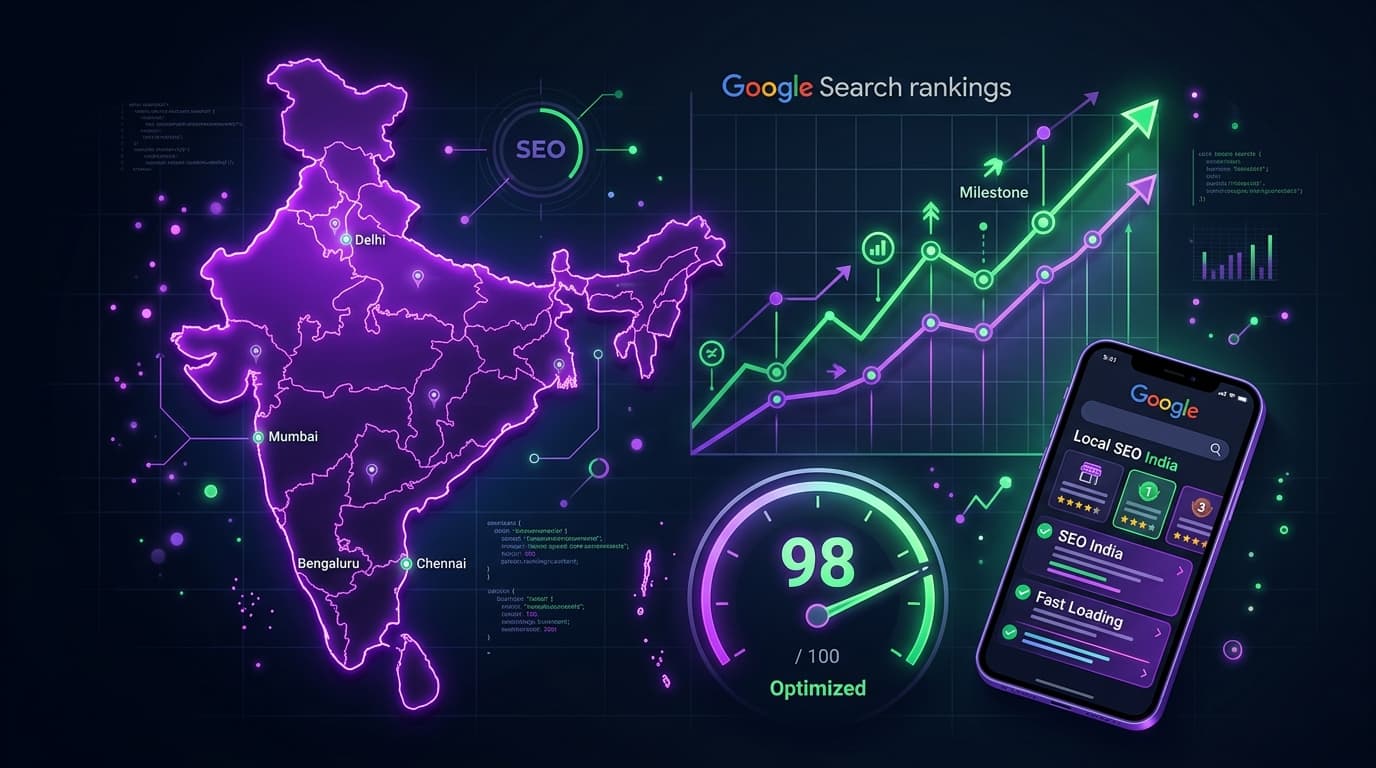
Introduction: Why Local SEO is the Single Biggest Opportunity for Indian SMBs
When a potential customer in Andheri searches "dentist near me" or someone in Pune types "CA services Kothrud," what decides who shows up? It isn't necessarily the biggest practice or the most established firm. It's the business that has invested in local SEO.
Local SEO — search engine optimisation focused on ranking for geographically relevant queries — is arguably the highest-ROI digital marketing activity available to Indian small and medium businesses today. And with the rise of AI-powered search, combining local SEO with AEO and GEO strategies gives you visibility across both traditional and AI search results. Unlike paid ads that stop delivering the moment your budget runs out, local SEO builds durable visibility that compounds over time.
At KT Solutions, we've helped hundreds of businesses across Mumbai, Pune, Ahmedabad, and beyond grow their footfall and enquiries through local SEO. This guide shares everything we know — distilled into an actionable playbook you can start using today.
What Is Local SEO and Why Does It Matter for Indian SMBs?
Local SEO is the practice of optimising your online presence so your business appears prominently when people search for products or services in your geographic area. This includes:
- The Local Pack (the map and three business listings that appear at the top of Google for local queries)
- Google Maps results
- Organic search results with local intent (e.g., "web design company in Mumbai")
Why it matters specifically for India:
India's search behaviour is intensely local. With 800+ million internet users — the majority on smartphones — people search for nearby businesses constantly. A 2024 BrightLocal study found that 76% of people who conduct a "near me" search visit a business within 24 hours. In India, where trust is often built locally, this figure is even more pronounced.
For a healthcare clinic in Borivali, a restaurant in Bandra, or a coaching institute in Dadar, appearing in the top 3 local results can mean the difference between a fully booked schedule and an empty waiting room.
Step 1: Google Business Profile — Your Most Powerful Local SEO Asset
Your Google Business Profile (GBP) — formerly Google My Business — is the foundation of all local SEO. It's free, powerful, and most Indian businesses either haven't set it up or have done it incorrectly.
Complete Setup Checklist
1. Claim and verify your listing Go to business.google.com and search for your business. If it already exists (Google auto-generates profiles), claim it. If not, create one fresh. Verification is typically done via a postcard mailed to your address, or increasingly via video verification.
2. Choose the right primary category This is critical. If you run a dental clinic, choose "Dental Clinic" — not just "Doctor" or "Healthcare." Google uses your primary category to determine what searches you're relevant for. You can add up to 9 secondary categories — use them wisely.
3. Fill every section completely
- Business name: Use your real business name. Do not stuff keywords here (e.g., "Sharma Dental Clinic — Best Dentist Mumbai" violates Google's guidelines and can get you suspended).
- Address: Must match exactly what appears on your website and other directories.
- Phone number: Use a local landline or a consistent mobile number. Avoid tracking numbers that change.
- Website URL: Link to your actual website homepage (or a dedicated landing page if you have multiple locations).
- Business hours: Include special hours for holidays (Diwali, Dussehra, etc.).
- Business description: Write a compelling 750-character description. Include your primary keywords naturally. Example: "KT Solutions is a Mumbai-based web design and SEO agency helping businesses across Maharashtra grow their online presence since 2010."
4. Add high-quality photos Listings with photos receive 42% more requests for directions and 35% more website clicks. Upload:
- Your logo (use the "Logo" photo category)
- Your storefront/exterior so customers can find you
- Interior photos that build trust
- Team photos
- Product/service photos
Aim for a minimum of 10 photos. Refresh them every quarter.
5. Add services and products Google allows you to list your services with descriptions and prices. This data appears in your profile and can trigger rich results. For a coaching institute, list each course with a brief description.
6. Use Google Posts weekly Google Posts are short updates (like social media posts) that appear directly on your GBP listing. Use them to announce offers, new services, or blog content. Posts with a photo and a clear CTA ("Book Now," "Learn More") perform best. We've seen clinics get 30–40 appointment requests monthly just from consistent GBP posting.
Step 2: NAP Consistency Across Indian Directories
NAP stands for Name, Address, Phone number — the three pieces of information that must be absolutely consistent across every online mention of your business. Google uses NAP data to verify that a business is legitimate and to determine local rankings.
The challenge for Indian businesses: NAP inconsistency is rampant. A business might be listed as "KTS Web Solutions Pvt Ltd" on JustDial, "KT Solutions" on Sulekha, "K.T. Solutions" on their website, and not listed at all on IndiaMART. Each inconsistency weakens your local authority.
The Most Important Indian Directories
Tier 1 — Must be 100% accurate:
- JustDial (justdial.com) — India's most-used local business directory. Extremely important for local signals.
- IndiaMART (indiamart.com) — Critical for B2B businesses.
- Sulekha (sulekha.com) — Strong for service businesses, especially in South India.
- TradeIndia (tradeindia.com) — Another important B2B directory.
Tier 2 — Important for citations:
- Yellow Pages India (yellowpages.co.in)
- Yelp India (yelp.com) — Lower traffic in India but Google trusts it.
- Bing Places for Business — Don't ignore Bing; it powers several AI assistants.
- Apple Maps — Set up your listing at mapsconnect.apple.com.
Tier 3 — Industry-specific:
- Practo (for healthcare)
- Zomato/Swiggy (for restaurants and food businesses)
- 99acres/Housing.com (for real estate)
- UrbanClap/Urban Company (for home services)
How to audit your NAP consistency
- Google your business name and phone number separately
- Check each directory result manually
- Create a spreadsheet: Directory | Listed? | Name exact? | Address exact? | Phone exact?
- Correct discrepancies one by one — you'll need to log in to each platform or contact support
This process is tedious but it directly impacts your local rankings. We typically complete NAP audits as part of our onboarding for every local SEO client.
Step 3: Local Keyword Strategy for Indian Cities
The backbone of local SEO content is the "[service] in [city/area]" keyword pattern.
How to research local keywords
Use Google Keyword Planner or Ubersuggest to find search volumes for combinations like:
- "web design company in Mumbai" (high intent, high competition)
- "web design company in Andheri" (lower competition, high conversion)
- "website designer in Bandra" (hyperlocal, very high conversion)
Pro tip: Don't just target the city. Indian searchers often use neighbourhood names. Someone in Thane won't search "Mumbai dentist" — they'll search "dentist in Thane West" or "dentist near Pokhran Road." Map your service areas to neighbourhoods and create dedicated landing pages for each.
Creating location pages that actually rank
For businesses with multiple locations or service areas, create individual pages for each location:
/services/web-design-mumbai/services/web-design-pune/services/web-design-thane
Each page must be genuinely useful — not just the same content with the city name swapped. Include:
- Local landmarks ("near Bandra Kurla Complex")
- Local customer testimonials
- Location-specific case studies
- Embedded Google Map
- Local phone number if possible
Step 4: Getting and Responding to Google Reviews
Reviews are one of the most powerful local ranking factors — and one of the most neglected by Indian businesses.
Why reviews matter
- Google's local algorithm explicitly factors in review quantity, recency, and sentiment
- 88% of Indian consumers trust online reviews as much as personal recommendations
- Businesses with 4.5+ star ratings get 28% more clicks in local results
India-specific tactics to get more reviews
1. The WhatsApp follow-up method After a positive interaction, send a WhatsApp message: "Hi [Name], thank you for visiting [Business Name]. We'd love to hear your feedback! Could you spare 2 minutes to leave us a Google review? Here's the direct link: [link]."
To get your direct review link: In Google Business Profile, go to "Ask for reviews" → copy the link.
2. QR codes at your premises Print a card or display a QR code at your checkout counter, reception, or table that says "Loved your experience? Tell Google!" In our experience, this alone can 3x the monthly review rate for restaurants and clinics.
3. SMS after service For businesses with a CRM or booking system, automate an SMS with the review link 2 hours after a service is completed.
How to respond to reviews
Respond to every review — positive and negative.
For positive reviews: Thank them, mention the specific service, and invite them back. Include a keyword naturally: "Thank you for your feedback on our dental implant procedure, [Name]! We're delighted you had a comfortable experience at our Goregaon clinic."
For negative reviews: Stay professional, acknowledge the concern, take it offline. Never argue. A professional response to a negative review often builds more trust than a perfect review.
Step 5: Local Citations — Which Ones Actually Matter in India
Beyond the major directories, local citations (any mention of your NAP online) build authority. Focus on:
- Chamber of Commerce listings — Mumbai Chamber, FICCI, CII, and state-level equivalents carry high authority
- Local news mentions — Times of India, Mid-Day, Hindustan Times local editions are powerful
- Industry associations — If you're a CA firm, a listing on ICAI's directory matters
- Local blogs and city guides — Mumbai Boss, LBB (Little Black Book), What's Hot India
Don't try to build hundreds of citations overnight. 20–30 high-quality, consistent citations outperform 200 inconsistent, low-quality ones every time.
Step 6: Schema Markup for Local Businesses
Schema markup is code added to your website that helps Google understand your business details. For local businesses, the LocalBusiness schema is essential.
At minimum, implement:
{
  "@context": "https://schema.org",
  "@type": "LocalBusiness",
  "name": "KT Solutions",
  "address": {
    "@type": "PostalAddress",
    "streetAddress": "Your Street Address",
    "addressLocality": "Mumbai",
    "addressRegion": "Maharashtra",
    "postalCode": "400001",
    "addressCountry": "IN"
  },
  "telephone": "+91-XXXXXXXXXX",
  "url": "https://www.ktsolutions.in",
  "openingHoursSpecification": [...],
  "geo": {
    "@type": "GeoCoordinates",
    "latitude": 19.0760,
    "longitude": 72.8777
  }
}
Also add FAQPage schema to your FAQ sections and Review schema if you're displaying testimonials. These enrich your Google listing and can trigger enhanced SERP features.
Step 7: Mobile-First Local Search in India
Over 70% of local searches in India happen on mobile devices. This means your local SEO efforts are only as effective as your mobile user experience.
Critical mobile optimisations for local search:
- Click-to-call: Every page must have a tappable phone number. Use
<a href="tel:+91XXXXXXXXXX">— not an image of a phone number. - WhatsApp button: A floating WhatsApp button converts significantly better than a contact form for most Indian B2C businesses.
- Maps integration: Embed a Google Map showing your location. Many customers tap "Get directions" before visiting.
- Page speed: Google uses mobile page speed as a ranking factor. A page that takes 6 seconds to load will rank lower and convert less. See our website speed and Core Web Vitals guide for specific fixes.
- Mobile-friendly forms: Contact forms with too many fields are abandoned on mobile. For enquiries, ask only for Name, Phone, and a brief message.
Common Mistakes Indian Businesses Make with Local SEO
Based on 500+ projects and local SEO audits across India, here are the mistakes we see most often:
- Keyword stuffing the GBP business name — This violates Google's guidelines and risks suspension.
- Using a PO Box or virtual office address — Google requires a physical, staffed address.
- Inconsistent phone numbers — Using a different mobile number on each platform.
- Zero reviews — Many excellent businesses have no reviews simply because they never asked.
- No photos on GBP — A listing with no photos looks abandoned and untrustworthy.
- Identical content on location pages — Duplicate content across location pages is penalised.
- Ignoring negative reviews — An unresponded negative review damages trust far more than the review itself.
- Not tracking results — No Google Analytics means no understanding of what's working.
Your Local SEO Checklist for 2026
Use this checklist to audit your current local SEO standing:
Google Business Profile
- Claimed and verified
- Primary category correctly set
- All fields 100% complete
- Minimum 10 photos uploaded
- Services/products listed
- At least 1 Google Post published this month
- Responded to all reviews in the last 30 days
NAP Consistency
- Identical NAP on website, GBP, JustDial, IndiaMART, Sulekha
- Listed on all Tier 1 directories
- Listed on relevant industry-specific directories
Website
- Location pages for each service area
- LocalBusiness schema markup implemented
- Click-to-call enabled on mobile
- Mobile page speed above 80 on Google PageSpeed Insights
- Embedded Google Map on Contact page
Reviews
- 15+ Google reviews minimum
- Average rating above 4.0
- All reviews responded to
Content
- At least 5 blog posts targeting local keywords
- Location-specific testimonials on service pages
- FAQPage schema on FAQ content
Frequently Asked Questions
How do I get my business to appear in Google's local pack in India?
Claim and fully optimise your Google Business Profile with accurate business information, the right primary category, high-quality photos, and regular Google Posts. Build consistent NAP (Name, Address, Phone) citations across Indian directories like JustDial, IndiaMART, and Sulekha. Collect Google reviews actively — businesses with 15+ reviews and 4.0+ ratings significantly outperform those without.
How important is Google Business Profile for local SEO in India?
Google Business Profile is the single most important local SEO asset for Indian businesses. It directly controls your appearance in Google Maps and the Local Pack — the map and three business listings shown for local queries. A fully optimised GBP with photos, reviews, and weekly posts can generate 30–50% of a local business's total enquiries.
How long does local SEO take to show results?
Local SEO typically shows initial improvements within 4–8 weeks for Google Business Profile optimisation and review generation. Ranking in the Local Pack for competitive terms usually takes 3–6 months of consistent effort including citation building, content creation, and review management. Unlike paid ads, the results compound over time.
What are the best local citation sites for Indian businesses?
The most important Indian citation sites are JustDial (highest local authority), IndiaMART (essential for B2B), Sulekha (strong for services), and TradeIndia. Also list on Yelp India, Yellow Pages India, Bing Places, and Apple Maps. For industry-specific citations, use Practo (healthcare), Zomato (restaurants), or 99acres (real estate).
Do Google reviews really affect local search rankings?
Yes, significantly. Google's local algorithm explicitly considers review quantity, recency, and sentiment as ranking factors. Businesses with more recent, positive reviews rank higher in the Local Pack. Reviews also influence click-through rates — listings with 4.5+ stars get 28% more clicks than those with lower ratings.
Conclusion
Local SEO isn't a one-time task — it's an ongoing process of building and maintaining your online reputation in your service area. But the compound returns are extraordinary. A healthcare clinic we worked with in Borivali went from 3 new patient enquiries per month to over 40 within 8 months, purely through local SEO — no paid ads.
The businesses that dominate local search in 2026 will be the ones that start today.
Need help with your local SEO? At KT Solutions, we offer comprehensive local SEO packages for Indian businesses — from GBP optimisation and citation building to schema markup and review management. Contact us for a free local SEO audit or explore our SEO services to see how we drive footfall and enquiries for Indian SMBs.